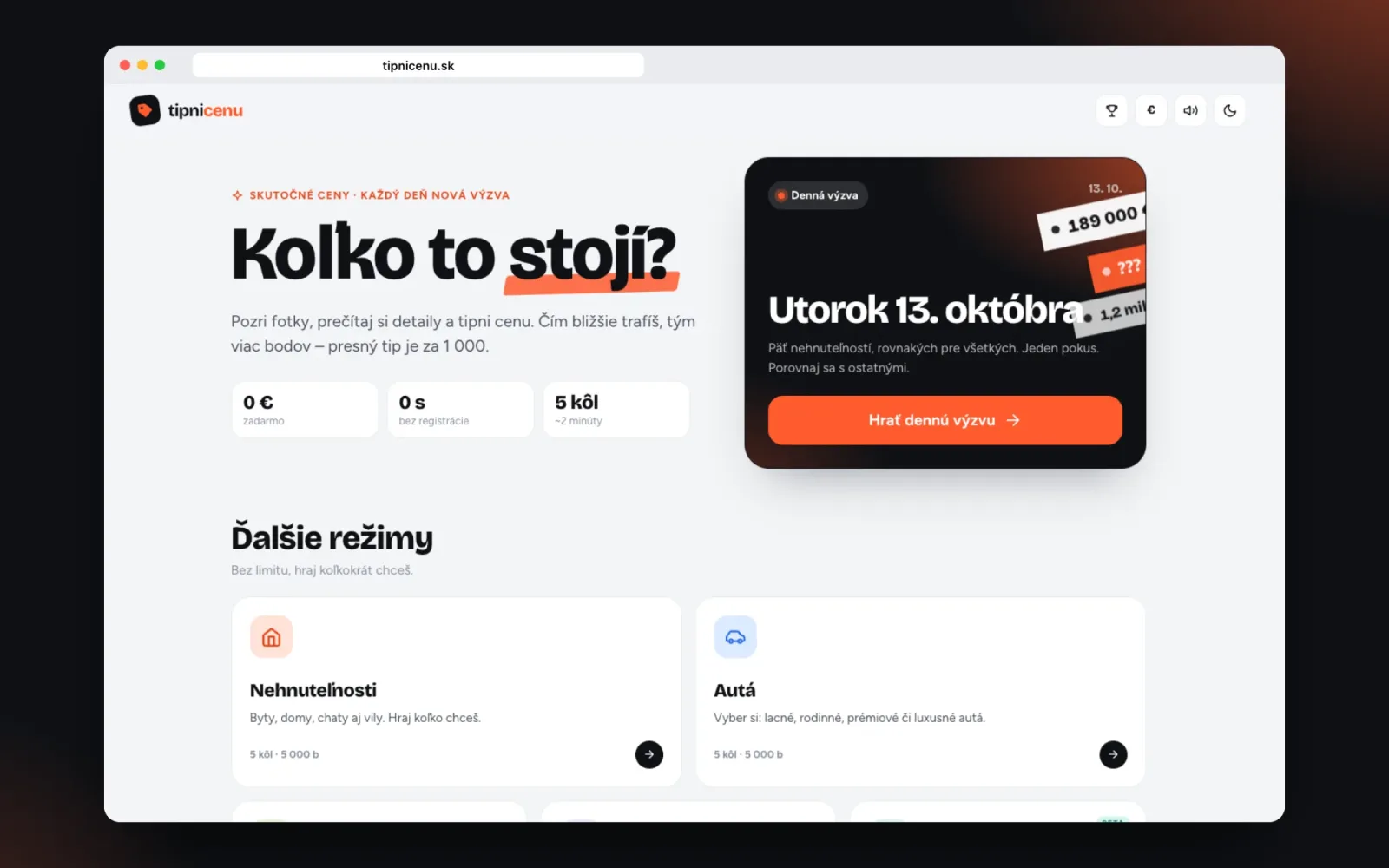
How much does a 3-room flat in Žilina cost? And a used Škoda Superb with 200,000 km on the clock? Most people feel they could estimate it. But when they actually have to guess for real, they're usually off by tens of percent.
That idea gave birth to Tipni cenu (a Slovak-language game), a free web game in which you guess the prices of real properties and cars from Slovakia. We designed, built and launched it at CODEUPP. In this article, we'll show you how we went about it, which technical decisions we made and what you can take away for your own digital product.
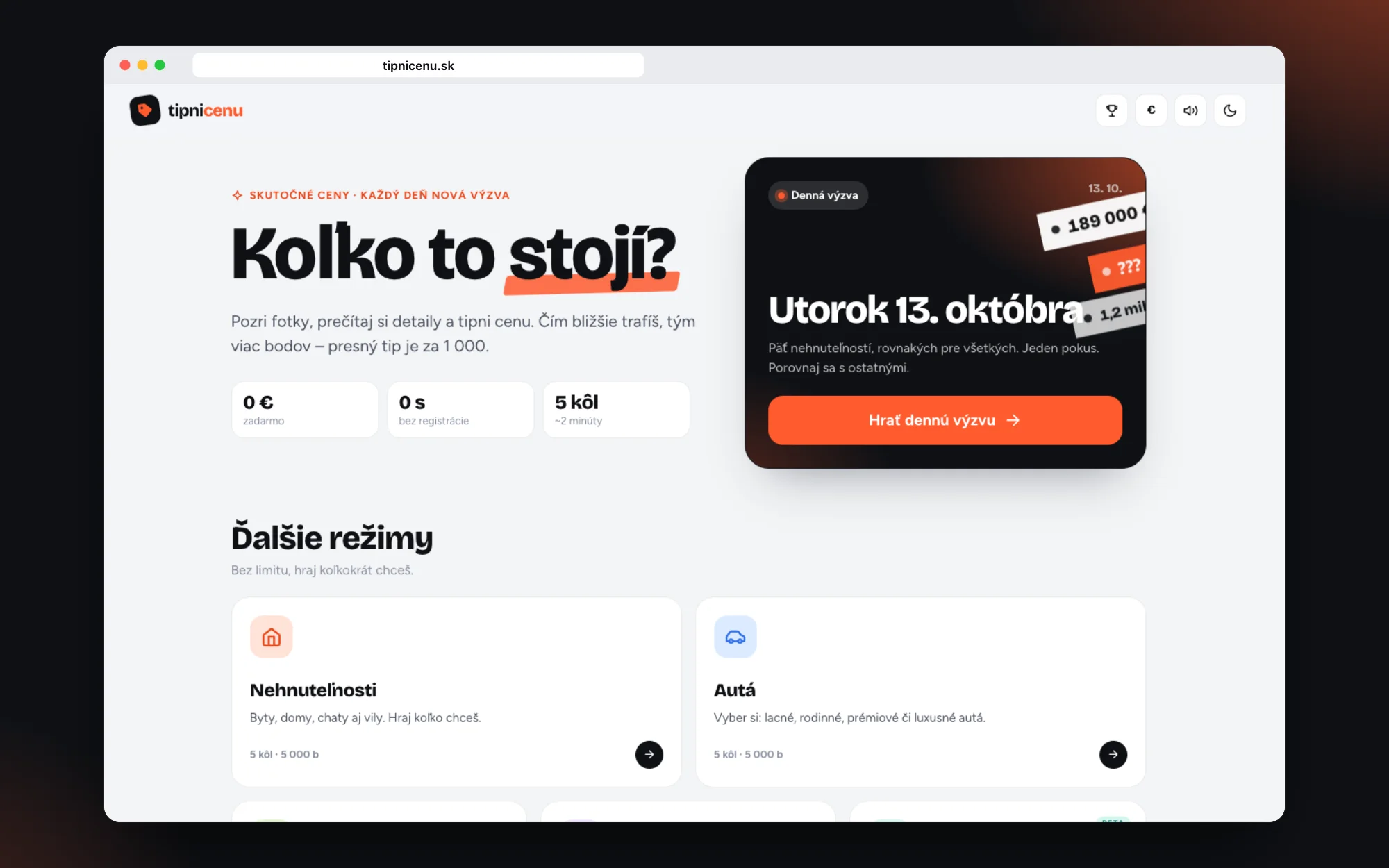
What the game is about
The principle is simple:
- You see photos and details of a real listing: location, floor area, number of rooms, year of manufacture or mileage.
- You guess the price using a slider or by typing in a number.
- A spot-on guess earns you 1,000 points. With a 10% deviation it's 750 points, and at 40% or more it's zero.

One game has five rounds and takes about two minutes. Besides classic guessing, Tipni cenu also offers other modes:
- Denná výzva (Daily challenge) – five properties, the same for everyone, one attempt per day and a daily leaderboard. It works just like Wordle: everyone gets the same puzzle and compares their results.
- Hádaj cenu auta (Guess the car price) – from cheap used cars to luxury sports cars.
- Čo je drahšie? (Which is more expensive?) – two listings side by side and you tap the pricier one.
- Násobič (Multiplier) – how many times more expensive is one property than the other?
- Hra s kamarátmi (Play with friends) – you create a room, send a link, and up to 10 people guess at the same time on their phones.
The game is free, with no sign-up and nothing to install. Just open the website.

Why would an agency build a game?
Short answer: because it's the perfect playground for testing the approaches we then use with our clients.
In a small space, the game covers everything a typical digital product has to deal with:
- processing and cleaning large amounts of data,
- mobile performance, because most players play on their phones,
- real-time features for multiplayer games,
- security against cheating,
- SEO and visibility in AI search engines, so that anyone finds out about the product at all.
On top of that, it's a product people share on their own. They share their result as an emoji grid, much like in Wordle, and every share brings in more players.
How we went about it
1. An MVP instead of a perfect product
The first version had a single mode: guessing property prices. No accounts, no leaderboards. We wanted to answer one question as soon as possible: do people enjoy it?
Only once it turned out they did, we added the daily challenge, cars, leaderboards and playing with friends. We take the same approach with client projects. We describe it in more detail in the article MVP in 30 days: how to validate an idea without wasting euros.
2. Simple technology that runs anywhere
We didn't reach for the latest framework. The game runs on plain PHP and JavaScript without a framework, with an SQLite database. The result:
- it runs on ordinary, cheap web hosting with no special server,
- it loads fast even on a weaker phone and a slow connection,
- maintenance is cheap and deployment takes a few seconds.
For smaller projects, this is often a better choice than a complex architecture that drives up costs for no reason. We choose technology based on what the project really needs, not on what's trendy right now.
3. Quality data as the foundation of the game
The game stands or falls on quality data. So we built automated processing of data on flats, houses and cars that:
- unifies the data into a single format,
- covers all regions of Slovakia, not just Bratislava,
- automatically resizes photos and optimises them into WebP,
- adds coordinates to locations, so you see a map with every property.
We use the same principle – automatically cleaning, unifying and enriching data – in business process automation.
4. Protection against cheating
In a game with a leaderboard, someone will always try to cheat. That's why the real price is never sent to the browser until the player submits their guess. Points are calculated by the server, not the browser. So you won't find the price in advance in the developer tools.
It's a small detail, but it decides whether anyone trusts the leaderboard. And the same principle applies to any application that works with sensitive data: the important things are always verified by the server.
5. Mobile first
Most players play on their phones, often one-handed on public transport. So we went through several rounds of tweaks:
- the guessing panel sticks to the bottom of the screen, like in native apps,
- you switch photos by swiping,
- the timer and score always stay visible,
- when you type a price, the panel shrinks to fit above the keyboard,
- after the result, the “Next round” button is always within thumb's reach.

Details like these aren't visible at first glance, but they're exactly what people use to judge whether an app is “nice to use”.
6. Playing with friends in real time
The ideal mode for parties and company events. One player creates a room and sends a link. The others join without signing up, and everyone guesses the same listings with a shared timer. After each round, they see who came closest.

7. SEO and visibility in ChatGPT, Gemini and Perplexity
Even the best game is useless if nobody can find it. And modern web apps have one nasty problem: the content is only rendered by JavaScript. Google partly copes with that, but Bing, DuckDuckGo and most AI bots (ChatGPT, Perplexity, Claude) don't run JavaScript. Instead of content, they see an empty page.
That's why we added to the game:
- a unique title, description and text for every page directly in the HTML, readable even without JavaScript,
- structured data (schema.org): the game, the operator, frequently asked questions,
- an llms.txt file that briefly explains to AI assistants what the website is and when to recommend it,
- IndexNow, so Bing, Yandex and Seznam learn about new pages instantly,
- robots.txt that explicitly allows AI search engines.
This discipline is also called GEO (Generative Engine Optimization), i.e. optimisation for AI search engines. More and more people ask ChatGPT instead of Google. If AI doesn't know you, then for part of your customers you simply don't exist.
What you can take away from this
Even if you're not building a game, these principles apply to any website, online store or app:
- Start with a small MVP and expand only what people are really interested in.
- Choose technology based on need, not trends. A simpler solution is often faster and cheaper.
- Automate your data work. Manual copying is expensive and error-prone.
- Design for mobile first. That's where most of your users are.
- Think about SEO and AI search engines from day one, not after launch.
Give it a try
The best way to understand it is to try it yourself. Play Tipni cenu and find out whether you can estimate the price of a flat better than a real estate agent. Or send the link to your friends and see which of you has the best estimate.
Got an idea for an app, a game or an internal tool? At CODEUPP, we design and develop custom websites and applications, help with SEO and visibility in AI search engines and can validate your idea as an MVP prototype in a few weeks. Get in touch for a free consultation.